Delivering high quality recombinant proteins through advanced mammalian expression

Introduction
A biotechnology client specializing in mAbs and other biologic modalities, rapid, high purity production of multiple recombinant proteins, including recombinant gene products (RGPs), scFab heteroFc constructs, and monoclonal antibodies, to support downstream research and assay development. The project was technically demanding: several constructs were prone to aggregation, precipitation during neutralization, and formation of unwanted species such as monomers and homodimers. These challenges made it essential to use a mammalian expression system capable of proper folding and post translational modification, paired with a purification strategy that could be adapted to each protein’s unique behaviour.
Enzene’s integrated mammalian expression and purification platform was selected to address these complexities and deliver high quality material within tight timelines.
Why did the customer approach Enzene?
The client approached Enzene because it needed a partner with the technical depth to overcome several modality‑specific challenges:
- Managing heterodimer complexity: The customer’s heterodimer antibody constructs generated unwanted monomers and homodimers, requiring a purification strategy capable of precise species separation.
- Preventing precipitation during neutralization: Post‑elution precipitation was a recurring issue, indicating the need for buffer and pH‑control expertise.
- Mitigating aggregation in multi‑domain constructs: Proteins such as [Fab‑scFv]‑heteroFc and certain mAbs showed significant aggregation, leading to product loss and inconsistent yields.
- Ensuring high purity across diverse constructs: The client required >97% purity for all proteins, which demanded a multi‑step, customizable purification workflow.
- Delivering reproducible yields from small‑scale cultures: The project required reliable expression from 100 mL cultures, with sufficient material for analytics and downstream assays.
Enzene was selected due to its ability to combine mammalian expression expertise with tailored purification strategies and in‑house analytical capabilities.
Enzene’s approach
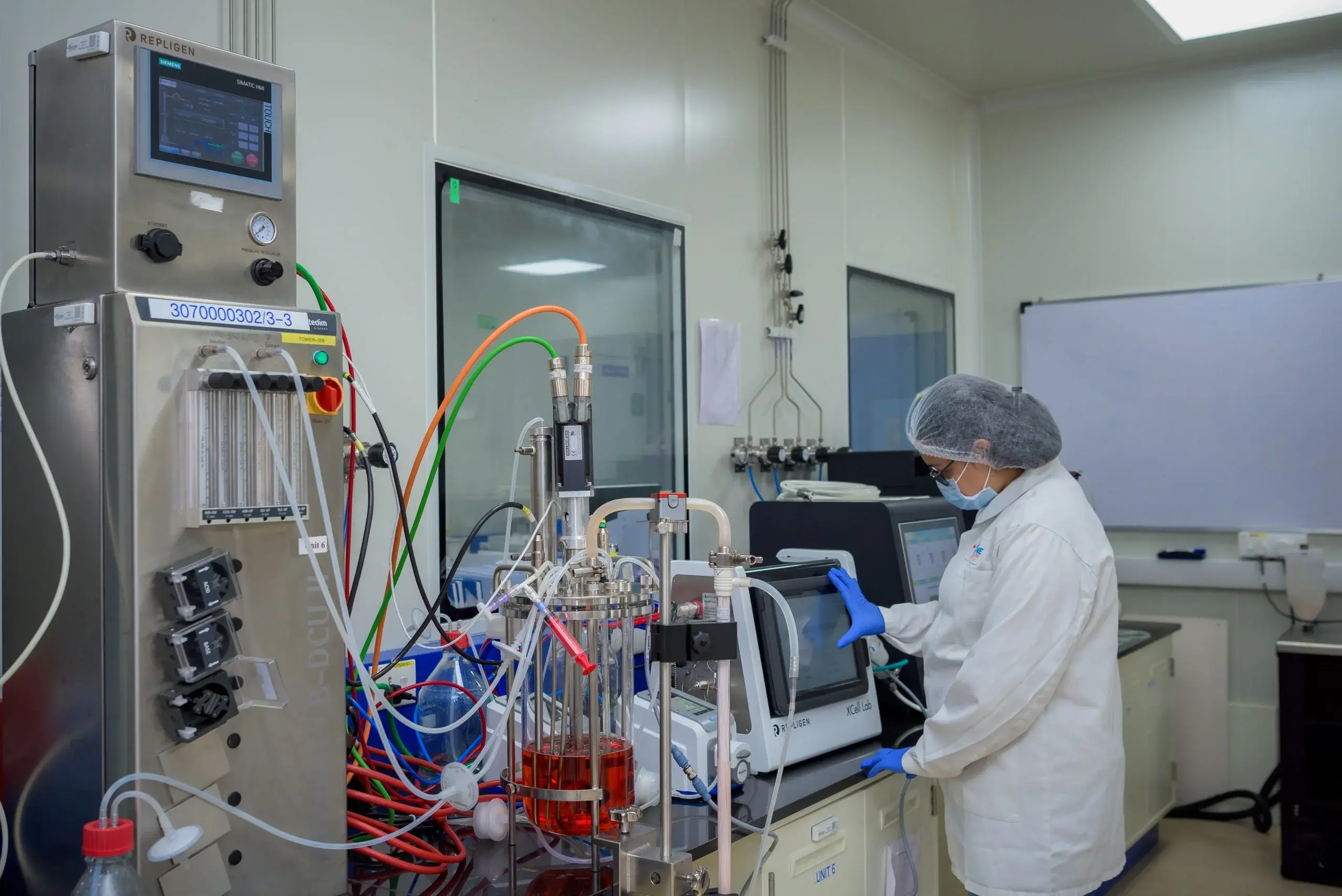
Enzene employed a mammalian cell‑based expression system built around CHO cells, which served as the primary host for recombinant protein production in this study. CHO cells provided the secretion efficiency and folding fidelity required for complex modalities, including Fc‑containing constructs and multi‑domain proteins. This platform helped minimize misfolding and aggregation while supporting stable, high‑quality expression. HEK293 cells were also available within Enzene’s expression toolkit, offering flexibility for constructs that benefit from human‑derived processing pathways, although CHO remained the main production host for this project.
To achieve the high purity specifications required by the client, Enzene implemented a customised, multi‑step purification workflow (Figure 1). The process began with affinity chromatography, using Protein A or Ni‑Sepharose depending on whether the construct carried an Fc or His tag. This initial capture step enriched the target protein and removed bulk impurities. The eluate then underwent ion exchange chromatography, either cation or anion exchange, allowing charge‑based separation to eliminate additional contaminants and refine purity. Finally, size exclusion chromatography was used as a polishing step to remove aggregates and ensure monodispersity. Each stage of purification was monitored by SDS‑PAGE, and final purity was confirmed using SEC‑HPLC, providing a robust analytical foundation for batch release.
Enzene also addressed several modality‑specific challenges through targeted troubleshooting. For heterodimer antibodies, the team encountered unwanted monomers and homodimers as well as precipitation during neutralization. These issues were resolved by replacing the standard Tris buffer with sodium phosphate buffer, which prevented precipitation and improved overall recovery. In the case of [Fab‑scFv]‑heteroFc constructs and monoclonal antibodies, aggregation posed a significant risk of product loss. Enzene mitigated this by implementing gentle pH adjustment through controlled acetic acid titration, reducing the likelihood of denaturation. An additional ion exchange chromatography step was incorporated to further enhance purity and remove aggregate species.
Outcomes
Enzene achieved consistently high purity across all recombinant proteins produced in this study. Final SEC‑HPLC analysis showed purity values ranging from 97.7% to 100%, a level that exceeds typical research‑grade expectations and demonstrates the effectiveness of the multi‑step purification workflow (figure 2). This high purity was maintained across diverse protein formats, including RGPs, scFab‑heteroFc constructs, and monoclonal antibodies, underscoring the robustness of the platform.
The project also delivered strong expression yields. Across the different constructs, Enzene obtained 2.95–9.6 mg of purified protein from 100 mL culture volumes, providing sufficient material for analytical characterization and downstream research applications. These yields reflect both the efficiency of the mammalian expression system and the effectiveness of the tailored purification strategy.
The observed yield range (2.95–9.6 mg) reflects molecule-specific differences in expression, folding, assembly, and downstream recovery. More complex formats, such as scFab-heteroFc and [Fab-scFv]-heteroFc constructs, required additional purification and aggregation-control measures, whereas simpler recombinant proteins exhibited higher recoveries while maintaining >97% purity.
Analytical confirmation further validated the quality of the final proteins. SDS‑PAGE and SEC‑HPLC were used to assess purity, aggregation status, and molecular integrity, providing a comprehensive view of product quality. The alignment between SDS‑PAGE banding patterns and SEC‑HPLC profiles confirmed that the purification workflow successfully removed aggregates and unwanted species.
The study also demonstrated successful resolution of modality‑specific challenges. Issues such as precipitation during neutralization and aggregation in multi‑domain constructs were mitigated through targeted buffer selection and controlled pH adjustment. The introduction of an additional ion exchange chromatography step further improved purity and reduced aggregate levels, ensuring that each protein met the required specifications.
Overall, the workflow proved reliable and reproducible across all protein types evaluated. Enzene’s customized approach enabled the team to adapt purification strategies to the unique behaviours of each modality, delivering high‑quality material suitable for downstream R&D. The consistency of results across constructs highlights the strength of the platform and its suitability for projects involving diverse recombinant protein formats.
Related case studies


Related CDMO solutions
The most advanced innovation is only one step away.
From discovery to commercial supply, an Enzene partnership brings a new way of thinking about biologics.
Let’s discuss your challenge or project.